Outsourcing the Drawing Board
Plus: I'm Running for State Representative

Wishing everyone a meaningful Memorial Day weekend. Sorry for the radio silence—hope this thing is still on. No excuses for the lack of Bureaucracy Posting, but I’m excited to start sharing more from my first year of grad school and ongoing research with the Niskanen Center State Capacity team. I have immense gratitude for my family, classmates, teachers, and colleagues for their support and constant inspiration.
In other fun news, I am running for State Representative here in Cambridge and Somerville! The key issues are exactly what I’ve been writing about:
Delivering public services that our neighbors can rely on
Bringing down the price of housing
Restoring transparency and accountability to state government
Fighting against Trump’s attacks and upholding our values as a welcoming, innovative community
More to come on here about the campaign, but for now you can check out my website, NeilMillerMA.com. If you aren’t local to MA, the best way to help is by donating. I’m running against an incumbent with $50k in the bank, so contributions of any size help us get our message out.
We officially kicked off the campaign on March 29, when I walked with 70 neighbors from one end of our district to the other. One day earlier, Cambridge Day published a great piece on why I’m running:

Miller told Cambridge Day “the reason that I’m running is that Massachusetts is a great place to live,” but it could be better. “There’s this gap between, I think, good intentions and the results that people see,” Miller said, citing oft-lamented legislative inertia.
Miller wants to hire in-house at the MBTA and MassDOT instead of paying external consultants; improve public service hiring pathways; and re-evaluate procurement rules to increase vendor competition. On housing, he wants to expand multifamily zoning rules statewide and remove parking mandates for new developments, he said.
“In-house hiring” and “increased vendor competition”: clearly issues which stir voters’ hearts and souls. Hopefully my messaging has improved since March. But the article is exactly right. Fundamentally I’m running because state government has failed to deliver. We see it in applications that don’t work. We see it in a housing shortage that enriches landlords and pits tenants against each other. And as I’ll get into here, we see it when transportation “planning” means 13 years of meetings and zero years of actual progress.
Boring as it may sound, “state capacity” means we’re able to actually act on our values. Put food on neighbors’ tables. Provide a home everyone feels secure in. And reconnect our cities by taking down highways and expanding public transit. To do that, we should hire and empower public servants. We need to stop relying on corporations and contractors who are motivated by profit, not public service.
To flesh this out, I’m sharing the term paper I wrote for Prof. John Donahue’s six-week course on Managing the Private Delivery of Public Value. We started our campaign kickoff on Magazine Beach in Cambridgeport, with the I-90 overpass visible (and audible) from across the river behind us. Travelling from Cambridge to visit family in Brookline, or even looking out the window of my apartment, the Mass Pike in Allston is a constant reminder of just how darn long it takes to get anything done in Massachusetts. Drawing on course readings; recent research by Liscow, Slattery, and Nober; my analysis of MassDOT workforce data; and publicly available info about relevant contracts, I argue that MA’s reliance on consultants has led to missed opportunities and unacceptable delays.
As always, please let me know what you think!
Yours in service,
Neil
Outsourcing the Drawing Board: Design Consultants and Delays to the I-90 Allston Project
“Do you think we’ll be in the ground by the end of this century?”1 Allston Civic Association president Tony D’Isidoro riffed, answering the phone when a Boston Globe reporter called in 2026. 13 years after planning began, major issues of project scope were still undecided. Despite substantial financial support from federal, state, local, and private partners for tearing down an overpass carrying I-90 through this Boston neighborhood, and unheard-of unanimous support for replacing it with a straighter, at-grade highway and transit hub, it seems like this project has missed its window of opportunity. The Massachusetts Department of Transportation (MassDOT) had committed to repair a crumbling viaduct, removing one argument for the larger project. $327 million committed by the Biden administration were not spent in time, and a Republican Congress took them back. As a local transportation paper’s headline put it, “It’s back to the drawing board, all over again.”2
That drawing board mostly sits with VHB, a locally headquartered engineering consultant. VHB and other firms have received millions for their work on the project.3 In this paper, I explore how MassDOT’s weakened staffing and reliance on consultants like VHB held the project back. Repeated MassDOT blunders – advancing plans that met foreseeable stakeholder vetoes and delays embracing proposals that garnered consensus – are the results of MassDOT’s vendor relationship. Building on recent research linking states’ low transportation planning capacity and reliance on consultants to high infrastructure costs, I will argue that misaligned incentives and increased coordination costs have held the I-90 project back – and kept Allston divided into two.
Costs, Capacity, and Consultants
Recent work by Liscow, Slattery, and Nober tries to answer a question relevant in Allston and beyond: “Why is it so expensive to build infrastructure in the United States?” After surveying state Departments of Transportation (DOTs) and constructing a dataset linking personnel to project costs, they found that state capacity explains variation in costs that persist even after considering climate, geography, density, and labor costs. State capacity, for the authors, is measured by a DOT’s personnel and practices. “Personnel” consists of the number and quality of DOT employees. The “practices” highlighted in the paper are whether the state encourages competitions for contracts and whether it manages those contracts well.4 In this section, I will pull out relevant findings from the paper, and then show how this project aligns with the paper’s narrative. While Liscow et al. suggests several mechanisms for low state capacity to increase project costs, I propose two others based on the Allston example: misaligned incentives and coordination costs.
Personnel
Citing federal reports about state DOTs’ capacity, Liscow et al. reports that “the majority of states rely on consultants for design work.”5 Yet in-house staff still matter tremendously. The introduction says that “states with fewer transportation employees per capita have higher costs.”6 Absolute employment numbers are correlated with outcomes: states where DOT employment shrank between 1997 and 2020 were more likely to report being understaffed, and “an increase in one DOT employee per thousand people is associated with a 26% decrease in project costs.”7
Beyond the number of employees, the quality of in-house engineers at state DOTs impacts cost. Using a constructed measure of employee quality,8 the paper finds that “[m]oving from the 25th to 75th percentile of Project Head quality is associated with a 14% reduction in costs per mile, amounting to more than three times the average engineer salary.”9 Emphasizing that retaining great staff usually saves money, the authors’ informal analysis “suggests that California’s DOT should be willing to increase the compensation of high-quality engineers by more than $300,000 per year to prevent them from leaving for the private sector,” even as a senior engineer’s maximum salary at the agency is $168,000.10
To assess MassDOT’s capacity relevant to the I-90 Allston project, I analyzed employment data from CTHRU, which reports all payroll transactions for Massachusetts state agencies.11 CTHRU contains full-year data from 2011 to 2025. My analysis code is publicly available on GitHub.12
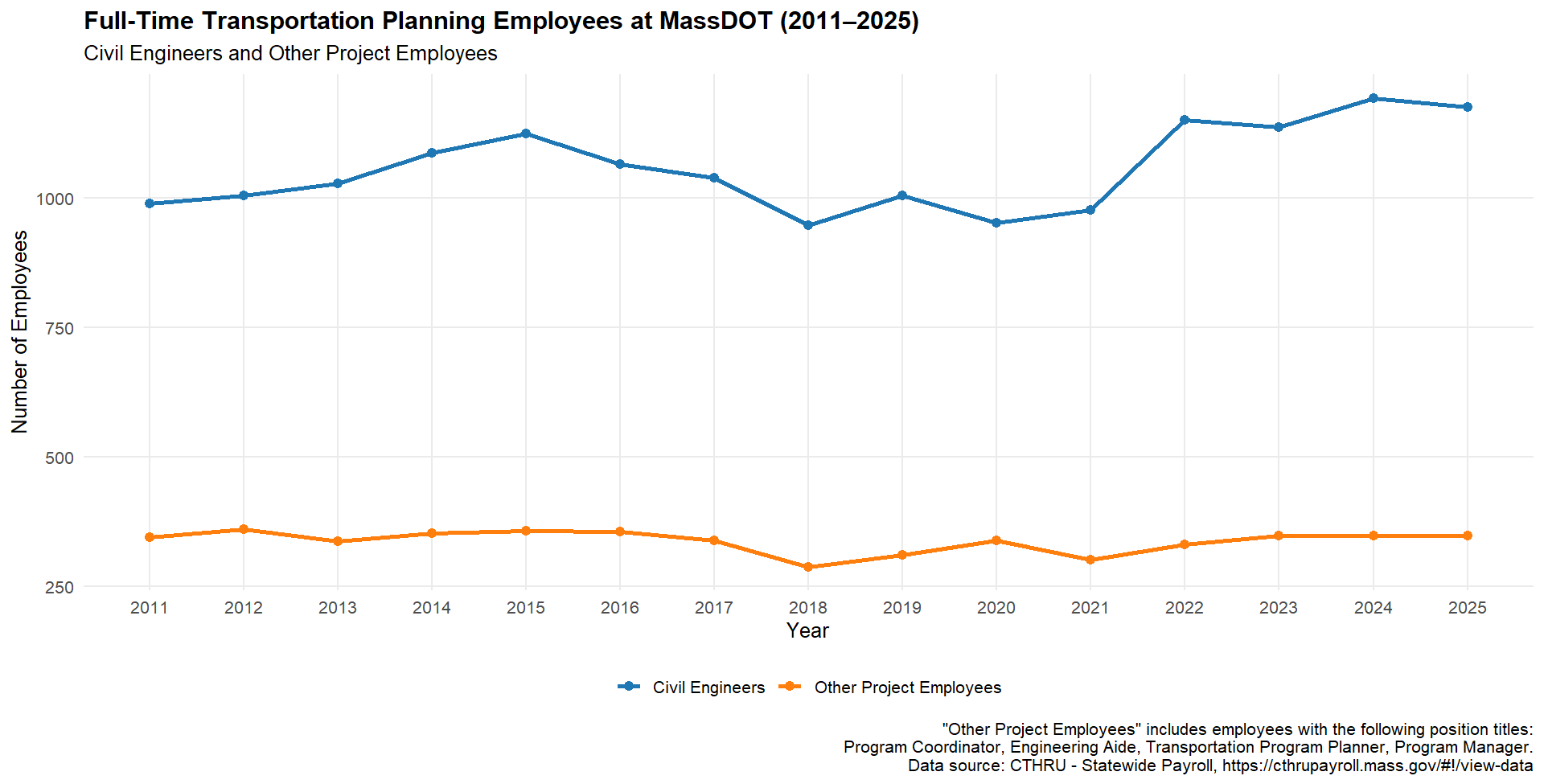
To see total MassDOT employment, I counted the number of full-time employees labelled as “Civil Engineer,” and the number of employees with other position titles related to transportation planning. The number of Civil Engineers at MassDOT rose significantly between 2013 and 2015, coinciding with the start of VHB’s work on the Allston project in 2014. However, engineering employment fell 5.2% in 2016 (from 1125 engineers to 1066), and again in 2017 and 2018. The engineering workforce did not surpass 2011 levels until 2022. Similarly, the number of employees in non-engineering roles related to transportation planning increased from 2013–15 and dropped 19.6% in the three subsequent years. As of 2025, “Other Project Employees” has not recovered to the 2015 peak. As Liscow et al. discuss transportation employees per capita, and the population of Massachusetts increased 7.4% through the 2010s, it is noteworthy that increased engineer hiring from 2022–25 still leaves MassDOT below 2015 levels after adjusting for population growth.13
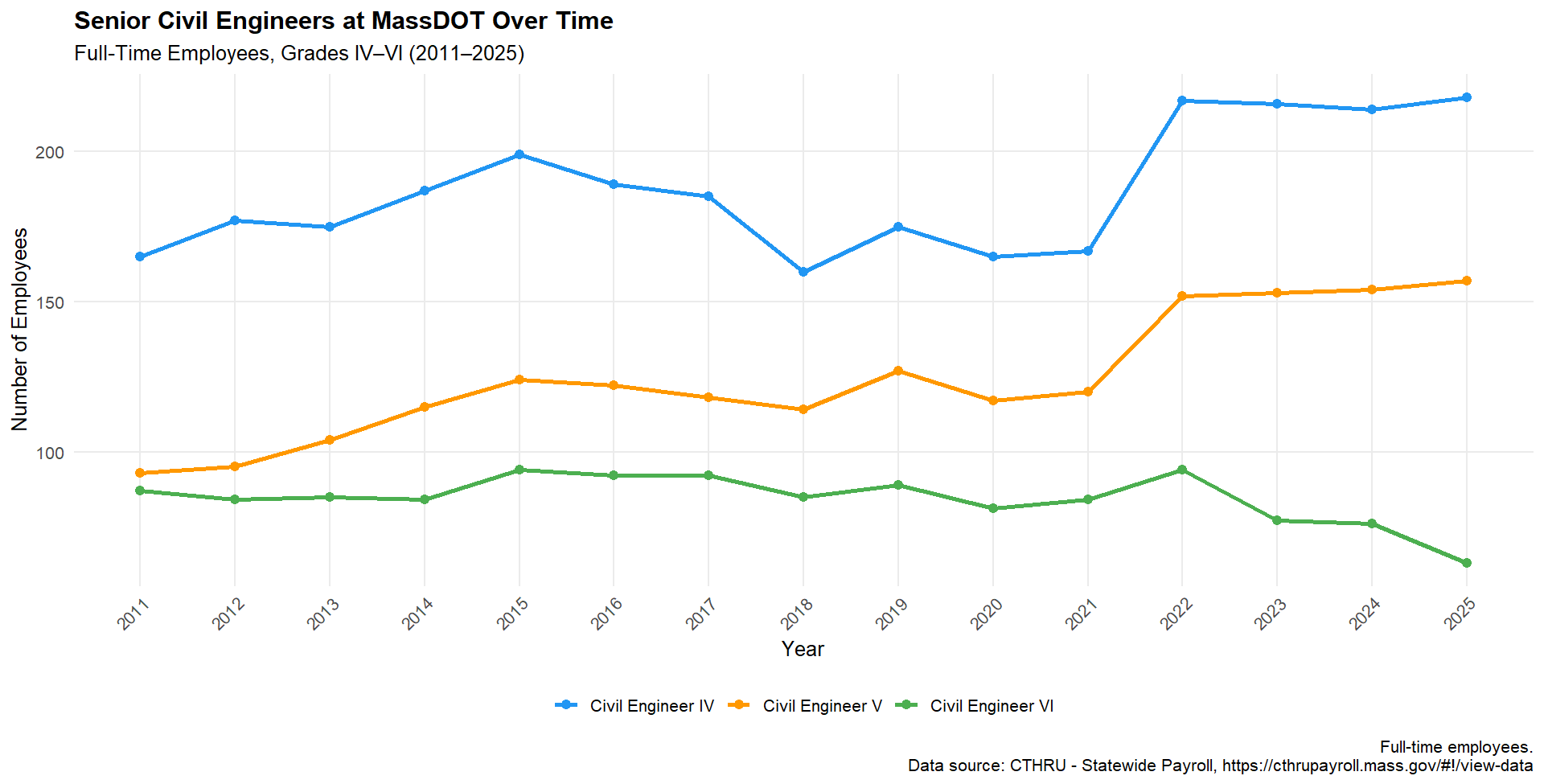
While no measure of employee quality is available, I also explored the number of civil engineers at more senior levels (grades IV, V, and VI). Top salaries for MassDOT civil engineers are similar to the California example discussed above, if not slightly lower. Minimum and maximum salaries are reported below for 2025:14
$101,791–148,682 for Civil Engineer IV
$107,751–170,454 for Civil Engineer V
$122,945–164,767 for Civil Engineer VI
Employment counts for all three grades increased from 2013 to 2015, then fell from 2015 to 2018. While the increased overall staffing beginning in 2022 may be a good sign for MassDOT’s capacity, it is concerning that employment at the most senior grade fell 33% from 2022 to 2025.
Practices
MassDOT’s procurement practices are difficult to evaluate from the outside, largely due to limited data availability and the inherent subjectivity of such a complex domain. StreetsblogMASS, a Boston-based publication which has covered the project extensively, said it “requested up-to-date copies of MassDOT’s contracts and invoices with VHB and numerous other consulting firms involved in the Allston Multimodal Project” in July 2024. As of February 2025, “[i]n violation of public records laws, the Commonwealth still has not fulfilled those requests.” My own search on the state’s procurement portal, COMMBUYS, returned a list of blanket contracts that VHB is active on and the dollars spent to date on each of them.15 It is likely that VHB’s current work is under the Facilities Engineering Services Statewide Contract PRF69, which was put out to bid in 2017.16 However, no pricing information is available regarding VHB’s work at either the master contract level or for purchase orders. Additionally, I could not find information on COMMBUYS or other state websites on the bidding process or contractual terms for a purchase order regarding VHB’s work in Allston.
Despite limited information, we can still apply several findings from Liscow et al. to MassDOT’s relationship with VHB. The authors emphasize competition: “[s]tates that engage in practices to increase competition—i.e., bidder outreach—have statistically significant lower resurfacing costs.”17 While we do not know the bidding process for VHB’s design work, their consistent involvement from 2014 onward, across multiple blanket contracts, suggests at least an incumbency advantage. Additionally, the paper reported that the most common cause of cost overruns, according to a survey of DOT officials and contractors, was “change of project scope.”18 As detailed below, MassDOT leadership has rescoped the project several times, for example by ordering reconsideration of a revised at-grade project and reversing their stance on the inclusion of a layover yard.
Mechanisms
Seeing MassDOT’s reduced in-house engineering capacity between 2015 and 2022, and their (at best) opaque procurement practices, Liscow et al. would predict high costs on a complex project like the I-90 redesign in Allston. Given that the project still lacks funding or a final design, and $70 million has already been committed for interim repairs,19 we already see that final costs will exceed what they might have been.
Why, specifically, does this occur? Liscow, Slattery, and Nober raise two potential mechanisms for low state capacity to increase highway project costs:
High-quality engineers can reduce costs by increasing bidder participation.20
Lack of institutional knowledge (due to excessive reliance on consultants) “can lead to both mistakes in the project plans and delays when communicating with contractors.”21
Two other possibilities emerge from the I-90 example. The first is misaligned incentives: if a design process is being driven by consultants who are being paid for their time, there is simply less pressure to get something done. Any design in Allston will inevitably be imperfect for some stakeholders – limited land necessarily implies tradeoffs – but someone needs to negotiate those tradeoffs and push towards consensus. A second mechanism is coordination costs. MassDOT has repeatedly moved forward on alternatives that were obviously unacceptable to stakeholders with legal or financial veto power. Assuming that no one was actively trying to waste time or money, the most likely explanation is that the project team did not know these proposals would effectively trigger vetoes.
And apparently, these mechanisms are very strong. For as the next section argues, given the widespread benefits of an I-90 redesign in Allston, it is actually surprising that nothing has gotten done.
Surplus
To frame our subsequent discussion of why the project has not moved forward, we should first step back and look at the benefits. The surplus that would be realized from this megaproject would be substantial, under any configuration. Among the parties who would gain:
Harvard would enhance the development potential of 90 acres of vacant land it owns, with options for lab or housing development.
The City of Boston would reap the benefits of Harvard’s development, including new housing, additional property tax revenue, and job growth.
Boston University and the Allston neighborhood would gain better access to the Charles.
Nearby municipalities such as Cambridge and Watertown would enjoy higher property values and additional transit options if the new West Station was fully developed. Cambridge would also be glad to not have to look at an ugly overpass across the Charles.
The MBTA (underneath MassDOT) and Amtrak could gain a much-needed layover facility, if it was included. MassDOT would also remove the liability of a crumbling overpass, plus thousands more MBTA riders.
This is just a partial list, but Harvard, Boston University, and the City of Boston’s 2023 pledge to spend $300 million on the project – “the largest amount of third-party funding a state transportation project has ever received”22 according to MA’s Highway Commissioner – are an indication of the value on the table.
But for all of the benefits, it is unclear when – and even if – this project will come to fruition. Drawing on the project history and theoretical contributions from Williamson and Leibenstein, I will argue that MassDOT’s reliance on design consultants including VHB are a primary reason why.
Incentives
Though there is substantial common benefit and a range of possible agreements that could work, each party has some conflicting interests. MassDOT and MetroWest state officials would have been happy to maintain I-90’s traffic capacity by reconstructing an overpass, while local advocates believe only an at-grade project will effectively reconnect the neighborhood, and Harvard wants at-grade to maximize access to their land.23 Similarly, MassDOT favors a layover yard, while Allston leaders and Harvard are opposed.24
Conflicting interests among stakeholders are not unique to the I-90 project in Allston. However, it stands out that none of the key stakeholders are both motivated and empowered to drive towards a resolution. MassDOT is the natural facilitator of these negotiations, both for their formal authority and their convening power as a government agency. MassDOT, however, is reliant on VHB to analyze whether a politically viable solution is also technically feasible. If a solution is technically feasible, VHB would be responsible for producing formal engineering plans and supporting documentation. But if VHB’s experts are being paid by the hour, or by the deliverable, their financial interest cuts against a prompt resolution of design disagreements. VHB’s decade-long engagement has included multiple MassDOT preferred alternatives, with compensation presumably increasing at each iteration.
VHB’s other projects – and even the I-90 project itself – illustrate counterfactuals where the firm could have moved the consensus forward. VHB has grown from 350 employees in the 1990s to around 2,200 in early 2026. The Boston Globe reported that, “[a]side from transportation, VHB’s biggest markets include commercial real estate and government work.”25 Their portfolio in 2024 included nine of the 10 largest active development projects in Boston.26 Perhaps because these nine projects are led by private companies with the capacity to advance their own financial self-interest, rather than an understaffed public agency, a majority of them are moving ahead.27 VHB in these instances did complete the necessary design work to the satisfaction of the developer and other stakeholders. In Allston, engineering plans have repeatedly created forward momentum by fostering consensus – but these proposals did not originate with VHB or MassDOT. Instead, the group A Better City (ABC) and their own engineering consultants who put forward:
The at-grade proposal which MassDOT agreed to evaluate in 202028 and ultimately accepted as their preferred option in 2021;29 and
A construction sequencing plan “that potentially accelerates the removal of the existing viaduct in earlier stages of the Allston Multimodal Project,” which MassDOT in 2023 said it was exploring as a means “to avoid the need for any temporary bridge structure to be constructed in the overall phasing.”30
Perhaps recognizing that a design contractor with an open-ended mandate is incentivized against moving quickly, MassDOT is now pursuing a more directional approach to vendors. In 2026, MassDOT plans to hire a consultant under a revised scope. MassDOT’s new Executive Director of the Megaprojects Delivery Office says that a task force including ABC and Allston leaders would not have access to this consultant, “explaining that her agency needs to remain the proper sounding board for their input.”31
Williamson and Leibenstein both shed light on VHB’s incentives. Williamson emphasizes opportunism, where one party to a transaction discloses information strategically.32 He notes that information impactedness (where one party has asymmetric access to information that would be costly for the other party to obtain) invites opportunism.33 While consultants are sometimes accused of making extra work to run up their bill (e.g. VHB pouring hours into plans they knew were not viable), this seems improbably malicious. Leibenstein’s concept of X-inefficiency, while not originally developed to evaluate inter-firm relationships, gives a more benign explanation. VHB lacks competition and motivation due to MassDOT’s management practices, and therefore works more slowly and produces less useful designs than it optimally could.
Coordination Costs
On several occasions when MassDOT has brought forward their own proposals – backed by VHB – those proposals were quickly revealed to be non-starters. MassDOT’s preferred alternative in 2019 involved building a “temporary” four-lane, 2,000-foot-long highway above the Charles River to carry traffic during years of construction.34 The state’s own environmental permitting agency “came out strongly against those plans,”35 and MassDOT withdrew the proposal. Last year, MassDOT went back on the transportation secretary’s pledge and advanced a plan that would include a yard for train layovers. This provoked public criticism from Harvard, which had increased its funding commitment “contingent upon [the] layover being removed.”36 The State House Majority Leader, who represents the area, also reacted negatively, wondering aloud if the community would prefer the status quo over a layover yard.
If VHB is recommending designs that critical stakeholders reject, it may indicate high coordination costs. As a contractor, VHB is not empowered to reach out directly to environmental regulators, Harvard, or local elected officials. Further, it is costly (in time or reputation) for VHB to ask MassDOT to ask these stakeholders about design concepts. This is related to the second mechanism suggested by Liscow et al., regarding institutional knowledge, but even more severe. If an understaffed DOT lacks institutional knowledge about local communities and their stakeholders, that can be remedied by hiring and training junior engineers. By virtue of having a more fluid workforce and covering a wider geographic area, contractors are even less likely to have the institutional knowledge that helps resolve politically complicated design problems.
Conclusion
Pinning the inaction in Allston on design consultants may appear overstated. Taking other potential explanations, though, we again find that the project had relatively bright prospects. Per Liscow et al., “[l]eading theories for high infrastructure costs include overregulation and litigation… citizen opposition… and political distortions.”37 To address two points, the Allston I-90 project has not been threatened with any litigation, and the only citizen opposition is that the project should move faster. Overregulation is a possibility. However, projects of comparable regulatory complexity (like decking over I-90 in Back Bay for multiple buildings and pedestrian infrastructure) have already been finished.38
Funding is an ever-present issue, especially with the project on hold due to recent funding rescission. However, the I-90 project had the benefit of a wide range of potential funding sources. Notably, Massachusetts passed the Fair Share Amendment in 2022, and since 2023 more than $2.5 billion has been appropriated for transportation.39 There were numerous federal opportunities, too: MassDOT twice failed to win funds for Allston through the USDOT Multimodel Project Discretionary Program, despite a $372M project on Cape Cod getting funding, before the $335M “Reconnecting Communities” grant was awarded. Adding in the unprecedented funding pledges by Harvard, Boston University, and the City of Boston, and low interest rates between 2009 and 2022, it seems availability of funding was less of an issue than the project’s readiness to use that funding.
One key aspect of “readiness” is having consensus behind a design. Looking back, consensus was very much in reach, and still is even as funding becomes scarce. Yet the MassDOT-VHB project team repeatedly made unforced errors, like rejecting an at-grade proposal they later adopted or wasting time on preferred alternatives that were dead in the water. Given MassDOT’s reduced staffing levels during critical years of planning, degraded state capacity is a culprit. This case suggests two mechanisms for reduced state capacity to increase project costs: design contractors’ misaligned incentives against moving projects forward and the heightened coordination costs for outsourced design teams.
While Liscow, Slattery, and Nober talk about outsourcing’s detrimental impacts on infrastructure costs, the I-90 example may stand as a more severe tale. If the status quo holds, outsourcing design may be the reason why widely beneficial infrastructure simply never gets built.
Jon Chesto, “There’s Plenty of Impatience to Go around in Allston on the Mass. Pike Megaproject,” The Boston Globe, January 21, 2026, https://www.bostonglobe.com/2026/01/21/business/allston-megaproject-massdot-consultant-highway-pike/.
Christian MilNeil, “With Loss of Federal Funding, MassDOT Will Re-Evaluate Its Allston I-90 Plans,” Streetsblog Massachusetts, July 25, 2025, https://mass.streetsblog.org/2025/07/25/with-loss-of-federal-funding-massdot-will-re-evaluate-its-allston-i-90-plans.
Christian MilNeil, “Designers’ Tempers Fray As Major Issues Remain Unresolved for Allston I-90 Project,” Streetsblog Massachusetts, February 3, 2025, https://mass.streetsblog.org/2025/02/03/designers-tempers-fray-as-major-issues-remain-unresolved-for-allston-i-90-project.
Liscow, Zachary D. and Slattery, Cailin and Nober, William, State Capacity and Infrastructure Costs (August 23, 2025). Yale Law & Economics Research Paper, Available at SSRN: https://ssrn.com/abstract=4522676 or http://dx.doi.org/10.2139/ssrn.4522676, pp. 2–4.
Liscow et al., p. 106.
Liscow et al., p. 1.
Liscow et al., p. 18.
To measure employee quality, the authors calculate “a residual of employees’ compensation which captures their experience, performance, and job-specific training.” Liscow et al., pp. 2–3.
Liscow et al., p. 3.
Liscow et al., pp. 3–4.
“CTHRU - Statewide Payroll Open Payroll,” accessed March 27, 2026,
Neil Miller, “MassDOT_state_capacity/MA Civil Engineer Data.R at Main · Neilsmiller/MassDOT_state_capacity,” GitHub, accessed March 27, 2026, https://github.com/neilsmiller/MassDOT_state_capacity/blob/main/MA%20civil%20engineer%20data.R.
MassDOT employed 1125 civil engineers in 2015, and 1194 civil engineers in 2014 (before dropping to 1176 in 2025). A 7.4% increase over 2015 staffing levels would require MassDOT to employ 1208 engineers.
Salary ranges exclude eight employees who are reported as neither being in a union or working in management, as they have a reported $0 annual salary.
“Vendor Profile - VHB. Blankets Information.,” COMMBUYS, accessed March 27, 2026, https://www.commbuys.com/bso/external/vendor/vendorProfileContractsInfo.sda?external=true&vendorId=00000516.
“Bid Solicitation for Bid Number BD-18-1080-OSD03-SRC3-19759,” COMMBUYS, accessed March 27, 2026, https://www.commbuys.com/bso/external/bidDetail.sda?docId=BD-18-1080-OSD03-SRC3-19759&external=true&parentUrl=bid.
Liscow et al., p. 2.
Liscow et al., p. 18.
“Press Release Repair Contract Approved for Existing Allston I-90 Viaduct,” Massachusetts Department of Transportation, March 17, 2023, https://www.mass.gov/news/repair-contract-approved-for-existing-allston-i-90-viaduct.
Liscow et al., 3.
Liscow et al., p. 20.
Bruce Mohl, “Boston, Harvard, BU Pledge $300m for I-90 Allston Project,” CommonWealth Beacon, August 23, 2023, https://commonwealthbeacon.org/economy/boston-harvard-bu-pledge-300m-for-i-90-allston-project/.
Taylor C. Peterman, “Harvard Advocates for ‘Robust Evaluation’ of ‘At Grade’ Approach for Mass. Pike Section,” The Harvard Crimson, August 30, 2020, https://www.thecrimson.com/article/2020/8/30/harvard-supports-all-at-grade-allston/.
Jon Chesto, “Harvard Criticizes MassDOT Plan for New Train Parking in Allston,” The Boston Globe, February 5, 2025, https://www.bostonglobe.com/2025/02/05/business/harvard-massdot-train-parking-allston/.
Jon Chesto, “VHB Continues Its Out-of-State Expansion under New Leader Bill Ashworth,” The Boston Globe, February 9, 2026, https://www.bostonglobe.com/2026/02/09/business/vhb-jetblue-ryan-serhant/.
“News | VHB Helps Advance Mega-Projects Transforming Greater Boston,” VHB, September 16, 2024, https://www.vhb.com/news/vhb-helps-advance-mega-projects-transforming-greater-boston/.
Of the nine projects, at least seven have received approvals or moved forward on construction since 2024:
Suffolk Downs broke ground on a new building in January 2026.
Dorchester Bay City received approvals from the Boston Planning Department in 2025.
425 Medford received BPDA Board approval in 2024.
Allston Yards received a construction permit in 2025.
On the Dot received BPDA approval in 2024.
Allston Yards received a construction permit and financing in 2025.
A hotel opened in 2026 on the Harvard Enterprise Research Campus.
“A Better City Conversations: I-90 Allston Project: Riverfront Analysis + Design Exploration with CBT and Perkins&Will,” October 9, 2020, A Better City, accessed March 27, 2026, https://www.abettercity.org/news-and-events/blog/a-better-city-conversations-i-90-allston-project-riverfront-analysis-design-exploration-with-cbt-and-perkins-and-will.
Christian MilNeil, MassDOT Picks ‘At-Grade’ Option for Allston/I-90 Project - Streetsblog Massachusetts, September 29, 2021.
“Press Release: Repair Contract Approved for Existing Allston I-90 Viaduct,” Massachusetts Department of Transportation, March 17, 2023, https://www.mass.gov/news/repair-contract-approved-for-existing-allston-i-90-viaduct. In addition to A Better City, MassDOT says this plan was also brought forward by members of Harvard University and the City of Boston.
Jon Chesto, “There’s Plenty of Impatience to Go around in Allston on the Mass. Pike Megaproject,” The Boston Globe, January 21, 2026, https://www.bostonglobe.com/2026/01/21/business/allston-megaproject-massdot-consultant-highway-pike/.
Williamson, Oliver E. “Markets and Hierarchies: Some Elementary Considerations.” The American Economic Review 63, no. 2 (1973): 316–25. http://www.jstor.org/stable/1817092. p. 317.
Williamson, Oliver E. “Markets and Hierarchies: Some Elementary Considerations.” The American Economic Review 63, no. 2 (1973): 316–25. http://www.jstor.org/stable/1817092. p. 318.
Christian MilNeil, “MassDOT Allston Plans Would Plant A Highway Over the Charles River - Streetsblog Massachusetts,” November 20, 2019, https://mass.streetsblog.org/2019/11/20/massdot-allston-plans-would-plant-a-highway-over-the-charles-river.
“A Rough Guide To Boston’s Allston/I-90 Megaproject (Archived Version) - Streetsblog Massachusetts,” May 26, 2022, https://mass.streetsblog.org/2022/05/26/a-rough-guide-to-bostons-allston-i-90-megaproject-archived-version.
Jon Chesto, “Harvard Criticizes MassDOT Plan for New Train Parking in Allston,” The Boston Globe, February 5, 2025, https://www.bostonglobe.com/2025/02/05/business/harvard-massdot-train-parking-allston/.
Liscow et al., p. 1.
This air rights project took place at Parcel 12. It currently holds a CitizenM hotel and the offices of CarGurus Inc., and the developers also built “a new MBTA Green Line entrance, pedestrian tunnel to the Hynes Convention Center, and revamped bus shelter.” It faced the additional regulatory complexity of winning approval from local land use bodies.
Catherine Carlock, “A Big Building. Over the Pike. For the First Time in a Long Time,” The Boston Globe, June 7, 2022,https://www.bostonglobe.com/2022/06/07/business/an-office-building-over-pike-first-time-long-time/.
MTA Center for Education Policy and Practice, “Fair Share Amendment | Massachusetts Teachers Association,” accessed March 27, 2026, https://www.massteacher.org/resource-library/fair-share-amendment.