Counting to $100 million
Shock and awfully bad data analysis

My last employer is beefing with my new employer.1
The General Services Administration told Federal agencies to end all their contracts with Harvard, in a May 27 letter. This sparked less outrage than the chaos cruelly heaped on foreign students days earlier, but was still widely reported on, by the New York Times, NBC, NPR, the New York Post, and the Harvard Crimson. These outlets all cite an anonymous administration official to report that the contracts are “worth an estimated $100 million”.2
Big round dollar amounts, deployed on the northeastern front of America’s culture wars, supposedly based on contracting data? Press X To Doubt.

The US government cannot cancel $100 million in contracts with Harvard. If every single contract was terminated tomorrow, the damage would be less than half that amount.
And to all you news producers out there, now’s the time to hire a handsome, charismatic procurement data correspondent. Give me a call for cutting contracting insights, beamed directly to your grateful viewers across the nation.
How to Lie with Contract Data
Want to impress your boss and mislead the American public? Learn procurement data and you’ll have plenty of opportunities.
Contractors themselves have known this for a while. Peep these press releases from four companies who were each awarded one of dozens of spots on the same SEC (Securities and Exchange Commission) multiple award contract. The contract’s “ceiling” was $2.5 billion – the absolute maximum spend allowed on that contract – but of course the big number always gets top billing.
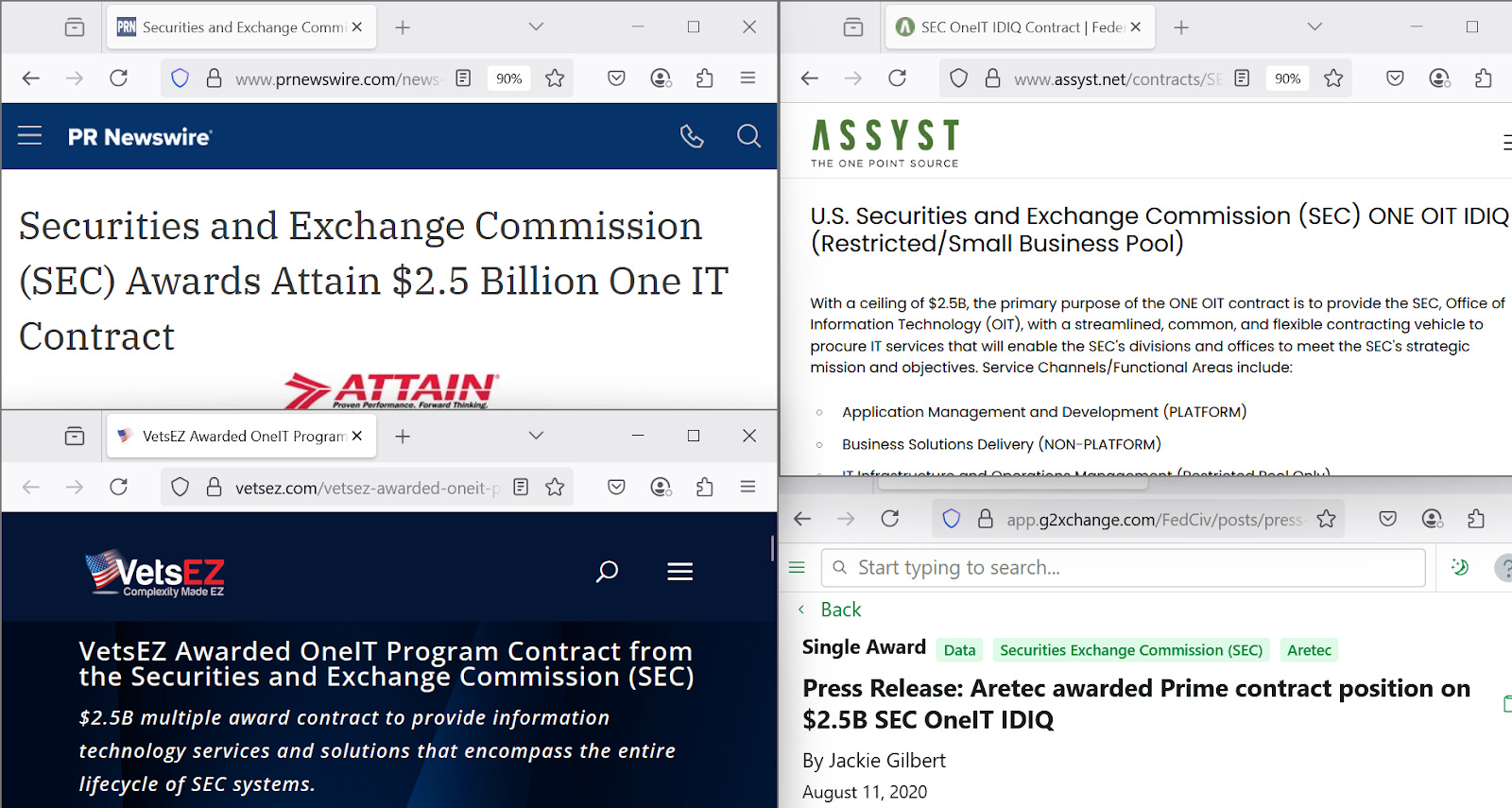
In reality, $2.5 billion is more than the SEC’s entire budget! A vendor is guaranteed $0 from being on one of these contracts; even 1/100th of $2.5 billion would be lucky. But hey, your investors don’t need to know that.
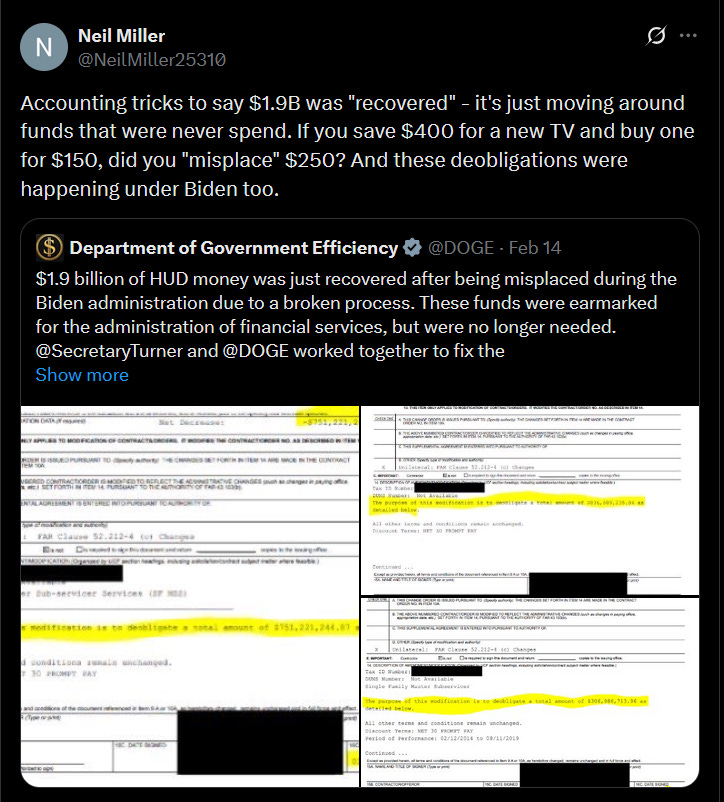
Credit to DOGE for bringing this entrepreneurial mindset into government. Among other errors, The DOGE.gov “Wall of Receipts” took credit for saving the full value of a contract ceiling and doublecounting overlapping contracts, as Deltek or CNN explained. To use the above example, it’s like pretending you saved $10 billion by terminating four contracts that are “worth” $2.5 billion. DOGE also claimed it “recovered” $1.9 billion by de-obligating funds held in reserve for mortgage servicing contracts – and only took it off their “Receipts” wall after I yelled at them on Twitter (probably).3
Arm yourself against boring misinformation
(Skip to the next section for a lowdown on Harvard’s contracts)
Misinformation typically preys on emotion: flames erupting, children crying, cities gripped by violence. DOGE’s blurry screenshots, on the other hand, wield boredom as a magic wand of misinformation. The docs they post look legit, with dollar amounts, legal clauses, wavy yellow highlighting. Even the informed, anti-DOGE commenters on Reddit’s r/fednews forum aren’t really sure what’s going on. Who cares enough to pull the data?
I do! And if you’ve read this far, maybe you do, too. I’ll give you some tips to avoid getting suckered by boring misinformation – but while you’re here, make sure you subscribe to stay in the loop.
First thing to know is that contract spending is public data – and has been for long before DOGE. The blurry screenshots are from FPDS.gov, but usaspending.gov is easier to use, especially to understand the history of a contract. Click “Search Award Data” on the top of the homepage, then you can put the contract identifier (PIID) in the “Keyword” field, or use the “Recipient” field, e.g. to search for entities connected to Harvard.
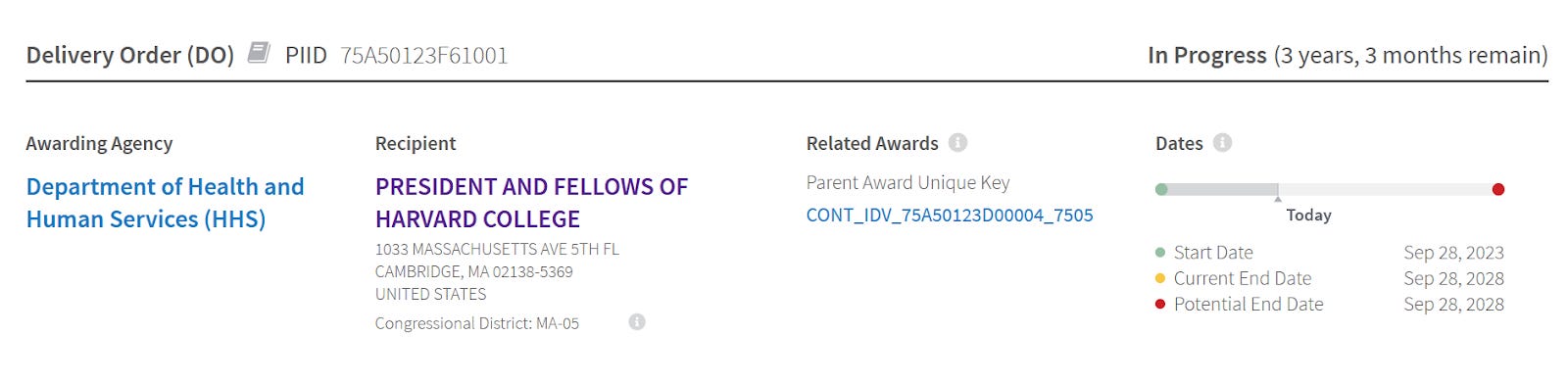
Then you’ll get a list like this one, of all the relevant contracts, sorted by “Obligations.” Click into one of them to get a contract summary:
A few terms that are helpful for analyzing Harvard’s exposure to cancelled contracts:
Start Date and Current End Date: the “period of performance” (sometimes called POP), which is when the vendor is doing work under this contract.
There may be administrative actions or payments made after the end date, but that doesn’t mean the contract is active.
Potential End Date: the latest that the period of performance could be, if all of the optional extensions are used.
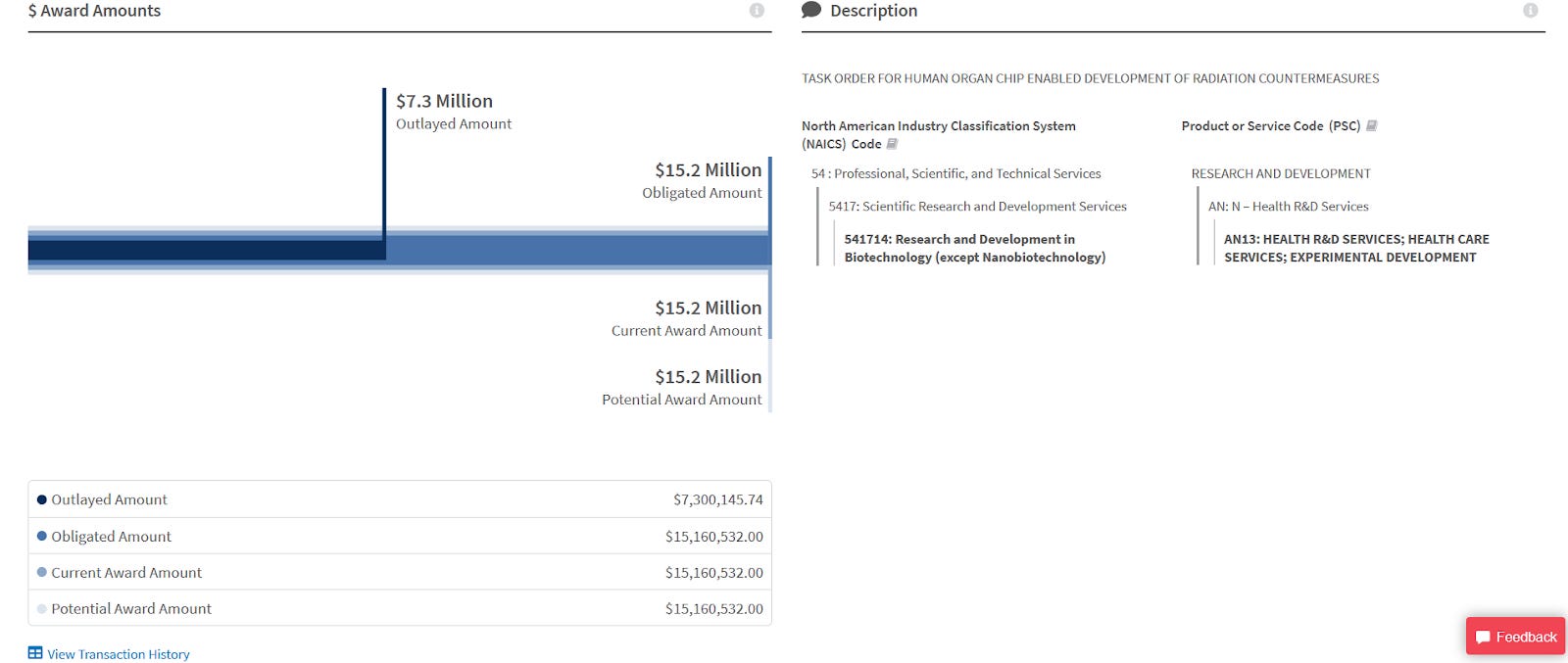
Obligated Amount: how much the government has set aside to spend on this contract. This is a promise to pay the vendor up to this amount, per the conditions in the contract.
Outlayed Amount: how much has actually been paid to the vendor. (Data quality here is inconsistent, since some agencies don’t link the $ they spend to contracts)
Current Award Amount: the maximum that could be spent under a contract, in its current state. The Potential Award Amount is the maximum if all options are exercised.
USAspending also gives data on grants, which are distinct from contracts. Most research is funded by grants, so the earlier threat to withhold grants has a much bigger downside; $2 billion is the figure quoted for Harvard. I’m not as familiar with grants data, but grant-watch.us reports that grant payments to Harvard declined in April (the latest data available) but aren’t dramatically lower year-over-year. Grant payments to four other universities have gone to $0: Northwestern, Brown, Columbia, and Cornell.
Grant disruptions are messing with lots of people I care deeply about—some of the most brilliant and dedicated humans I’ve ever met. By focusing on contracts, I don’t want to suggest that the funding cuts aren’t a big deal. They’re atrocious. My only goal is to find the truth, and not give in to Trump governing by lies and intimidation.
Trump Can’t Un-Spend Money
Now that you know more about contracting than DOGE does, we can dive into Harvard’s contracts.
The search I used is here; that page will update real-time, so you can check back in a month for fresh data. It returns any contracts with action taken (even just paperwork updates) since January 2024. These are all the contracts awarded to Harvard University, its schools, even the Harvard Business School Publishing Corporation, and also the Broad Institute—more on that in a second. The anonymous official who gave the $100 million figure reportedly said Harvard-related hospitals like Mass General aren’t impacted.
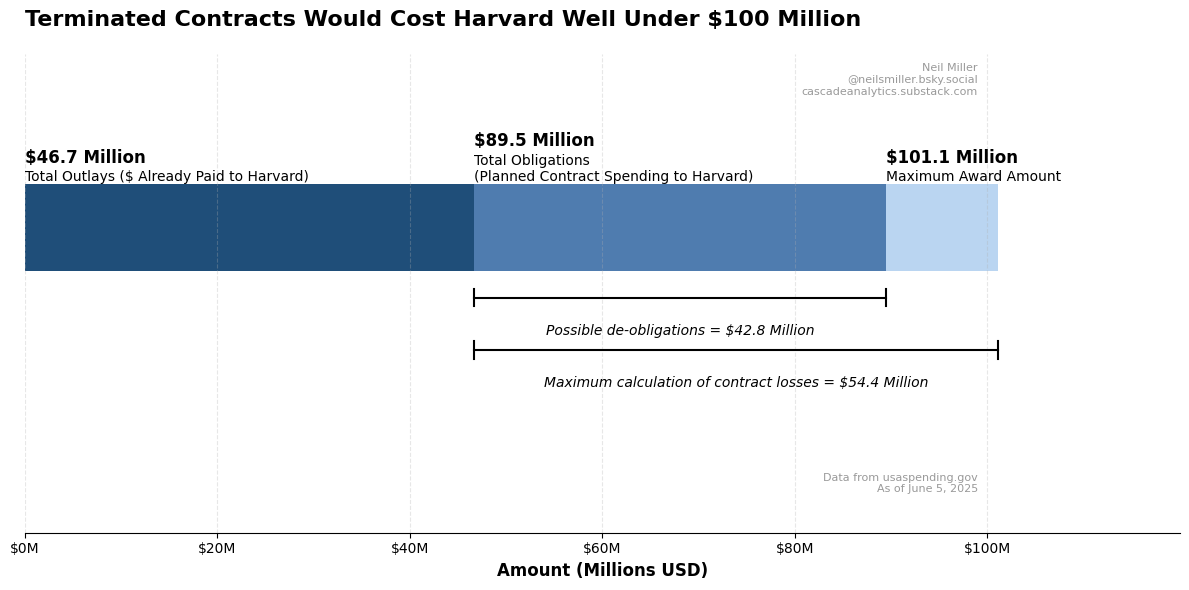
The absolute highest calculation of Harvard’s loss from contract terminations is $54.4 million. This is comparing the maximum possible spend (potential award amount) on all contracts, vs. current outlays.
A more honest sum of Harvard’s potential loss, in my opinion, is $42.8 million. This is comparing money already obligated to funds outlaid.
My annotated data can be accessed here.4
$42.8 and $54.4 million are most certainly overcounts. As noted above, “Outlayed Amount” is often missing data; the VA contracts that look to have the third and sixth largest unspent budgets probably have unreported outlays around $4 million, since they’re both at least 80% of the way through their period of performance. None of the VA contracts report their spending, but it’s unlikely the contracts were sitting inactive for years. On that logic, estimates are closer to $38.8M or $50.4M in possible lost funds.
Once again, those figures are absolute maximums. They presume that there’s $0 in open invoices for work already completed,5 and that all the contracts will be terminated immediately. We’re ten days past GSA’s June 6 deadline, and no cancellations have been reported, so there’s no sign these assumptions are true. GSA has no authority over other agency’s contracts, as the gentle “encourage,” “recommend,” “assist” language in its letter betrays. Like many Trump pronouncements, the letter may be full of sound and fury, signifying nothing – time will tell.
Half of the potential financial loss stems from two contracts. I’ll be watching for updates here to see how aggressively GSA’s wannabe-diktat is followed:
75A50123F61001 has recorded outlays of $7.3 million, with maximum contract value of $15.2 million. This research was previously described as developing “organs-on-chips” to help people recover from radiation poisoning, as after a nuclear incident.
75N93019C00071, funding Tuberculosis research, is by far the largest contract. So far, $34.5 million has been outlaid out of $53.6 million obligated. As The Times reports:
“The Harvard researcher Dr Sarah Fortune was only two years away from creating a vaccine that could have saved the 1.25 million people killed each year by tuberculosis. But last month, she received a letter telling her that the $60 million grant funding her research was being halted by President Trump.”
For what it’s worth, both of these contracts seemingly had significant outlays reported for April, which is the most recent data available at present. Spending for May should be reported at the end of June.
After all this, it’s likely that the unnamed administration official’s $100 million estimate refers to the total potential award amount across all Harvard contracts, which I calculate as $101.1 million. But Trump can’t take back the $46.7 million in payments that have already gone out. A big number sounds scarier – doesn’t mean it’s true.
It’s possible that the $100 million figure also includes contracts with the Broad Institute, an independent biomedical and genomic research center that often partners with MIT and Harvard. These contracts have unspent obligations of $56.6 million, for instance providing services through TOPMed to advance precision medicine. If you add $56.6 million to the $42.8 million in potential Harvard de-obligations, that’s close to the target. GSA’s letter doesn’t say anything about Broad, and Broad scientists obviously have no say in Harvard’s admissions or supposed anti-semitism. There’s no public indication that Broad is being attacked as part of the crusade against Harvard. If they are, the dozens of reporters on this beat should make the collateral damage to our health and the freedom of association clear to all.
What are the stakes?
$100 million, $50 million – what’s the difference? Clearly there will be cuts; maybe the real number isn’t important.
I disagree.
First, any promise becomes a goal. When deportations fell short of expectations, ICE became more unhinged in a drive to meet their numbers. If everyone accepts that there are $100 million in fat you can cut off Harvard contracts, and only $40 million materialize, there’s pressure to terminate more and more erratically.
Further, boring misinformation is effective politics, and just as effectively countered. Trump’s base is the audience for this $100 million ploy to own the libs, just as much as the Harvard administrators that Trump is negotiating against. Like grainy DOGE tweets, MAGA eats up Harvard cuts as proof that Trump is winning. If even Fox reports that Elon Musk “struggled to reach his original estimates of $1-2 trillion in cuts,” and his plummeting popularity drained DOGE’s influence, we should call out this new set of lies about Harvard’s finances. Once the propaganda fades, focus will shift, and conscientious civil servants will be able to do their jobs (like shepherding and funding research) with less meddling.
As the gears of the Federal government get thrust into battle against Trump’s opponents, it’s more important than ever to have a clear-eyed view of what’s real in the bureaucracy – and what’s exaggerated for political impact. I analyzed contracting and HR data for 3.5 years as a Federal government data scientist, and now I’m writing to share what I learned with you.
I’m also building tools like the Sole Source Spotter to keep tabs on potential misuse and abuse of Federal contracting, and researching how state governments should fix contracting if they want to help vulnerable residents amid Trump’s cuts to public benefits.
To support this work, you can donate via Buy Me a Coffee, and I’ll keep in touch about new articles and tools I’m working on.
If you’d like to keep learning how the bureaucracy works, subscribe to receive future articles in your inbox.
OK, I’ll mostly be a student, but I did just start a part-time research assistant gig at Harvard. Opinions and analysis are all my own, does not imply endorsement by Harvard or anyone else, etc.
Quoting from the New York Times.
If HUD issues a mortgage, and then the home is foreclosed on because the mortgage isn’t paid, the companies on these contracts maintain the home until it’s put back on the market. Thankfully, foreclosure rates are low – people are paying their mortgages – so these services were needed less than expected. That’s why $1.9 billion was “obligated,” or set aside, but never spent. It makes sense to “de-obligate” some of these funds, and that already began in 2024 (see e.g. action listed here on 09/25/2024); absurd to make it a political issue.
To recreate the metrics in the chart, filter to just contracts with Harvard (excluding the Broad Institute) and then sum over the transactions where Calc: valid = 1.
If the Federal government simply refuses to pay for work already completed, Harvard can sue for breach of contract in the Court of Federal Claims. This is a big burden for most vendors, but Harvard’s already fighting in court on countless other issues – what’s one more lawsuit?